Draw a Card. See Leominster Differently
Leominster Micro-Bursay Project
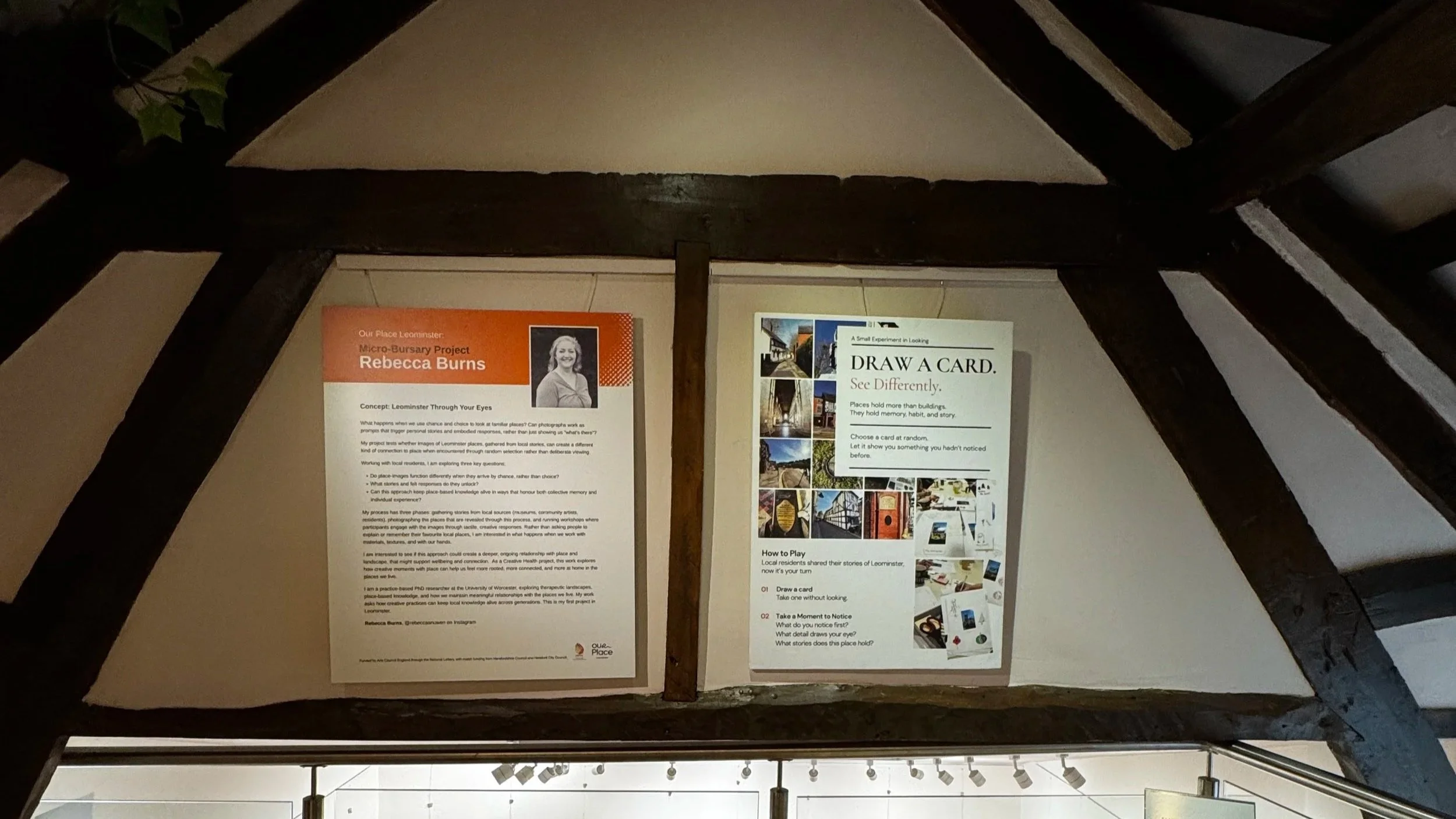
A place-based pilot exploring how simple, participatory methods can support connection to local environments.
Developed through a micro-bursary project in Leominster, Herefordshire, this work tested how creative prompts and shared reflection might help people notice, interpret and engage with familiar places in new ways.
Funded by the Arts Council England through the National Lottery, with match funding from Herefordshire Council and Hereford City Council.
About the Project
The Leominster pilot was designed as a small-scale, exploratory study into how people relate to place in everyday settings.
Rather than focusing on formal heritage or curated narratives, the project centred on ordinary locations, lived experience and personal memory. It asked how people encounter place through attention, conversation and interpretation, and how those encounters might be deepened through simple, creative methods.
WHAT WAS DONE
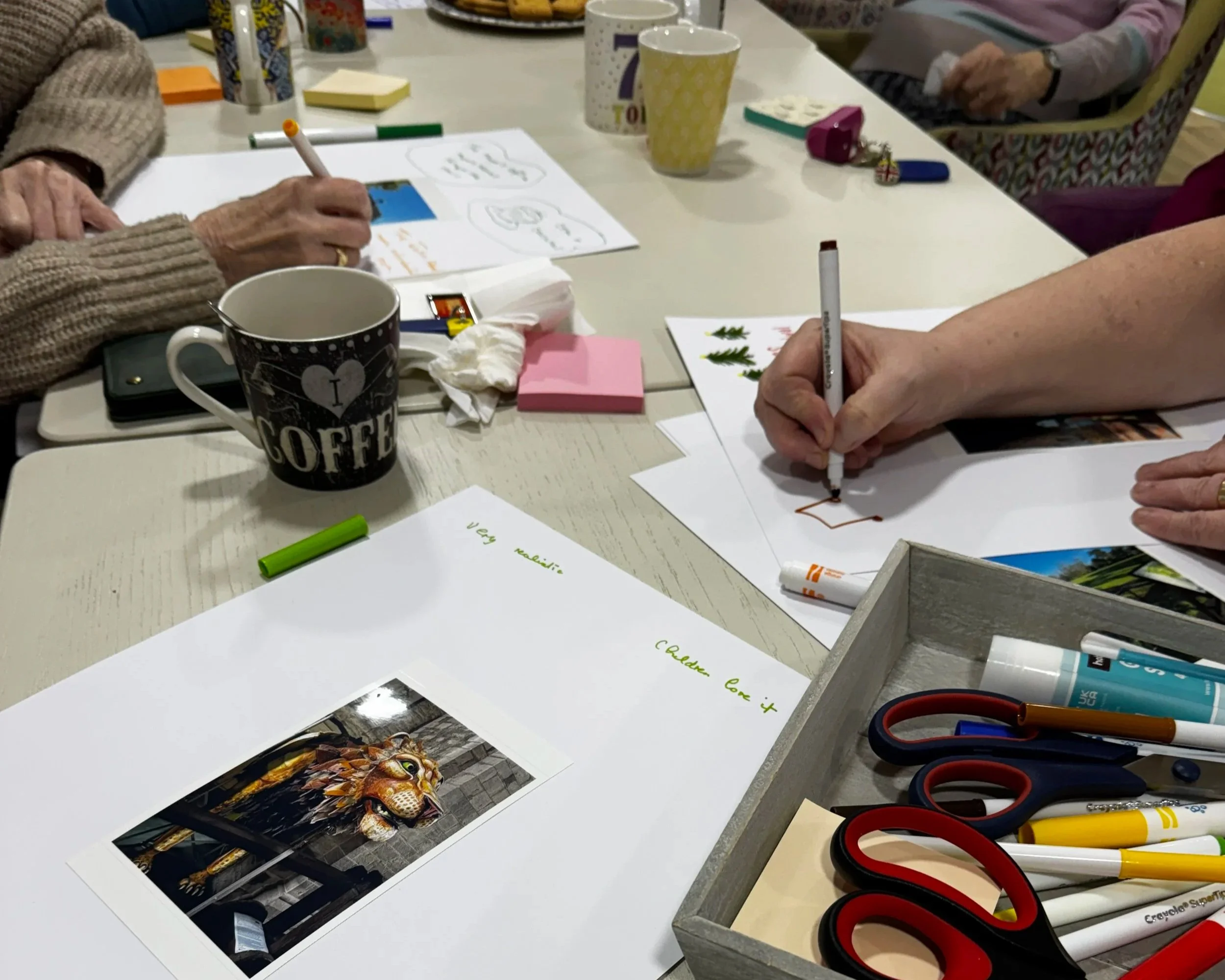
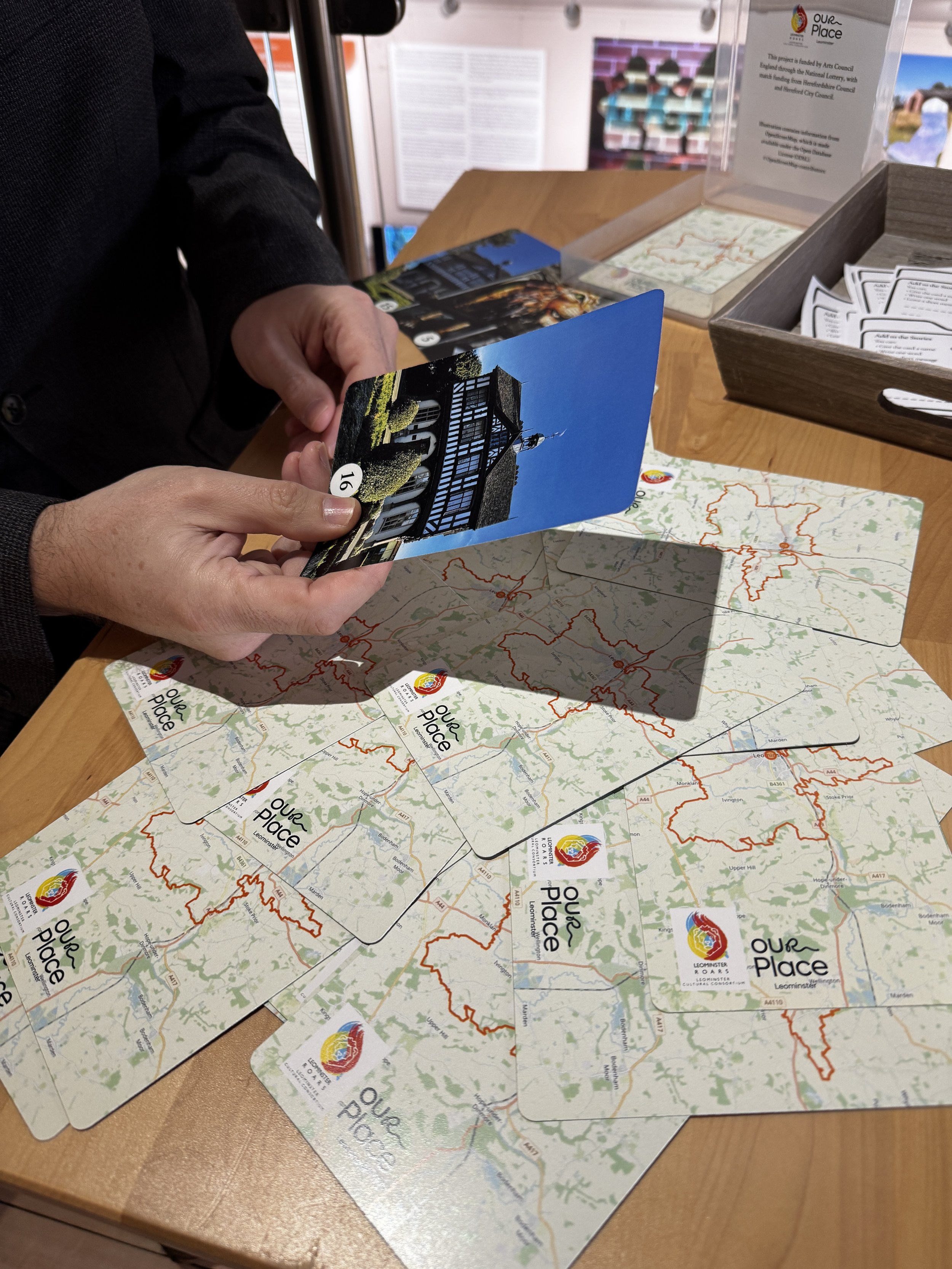
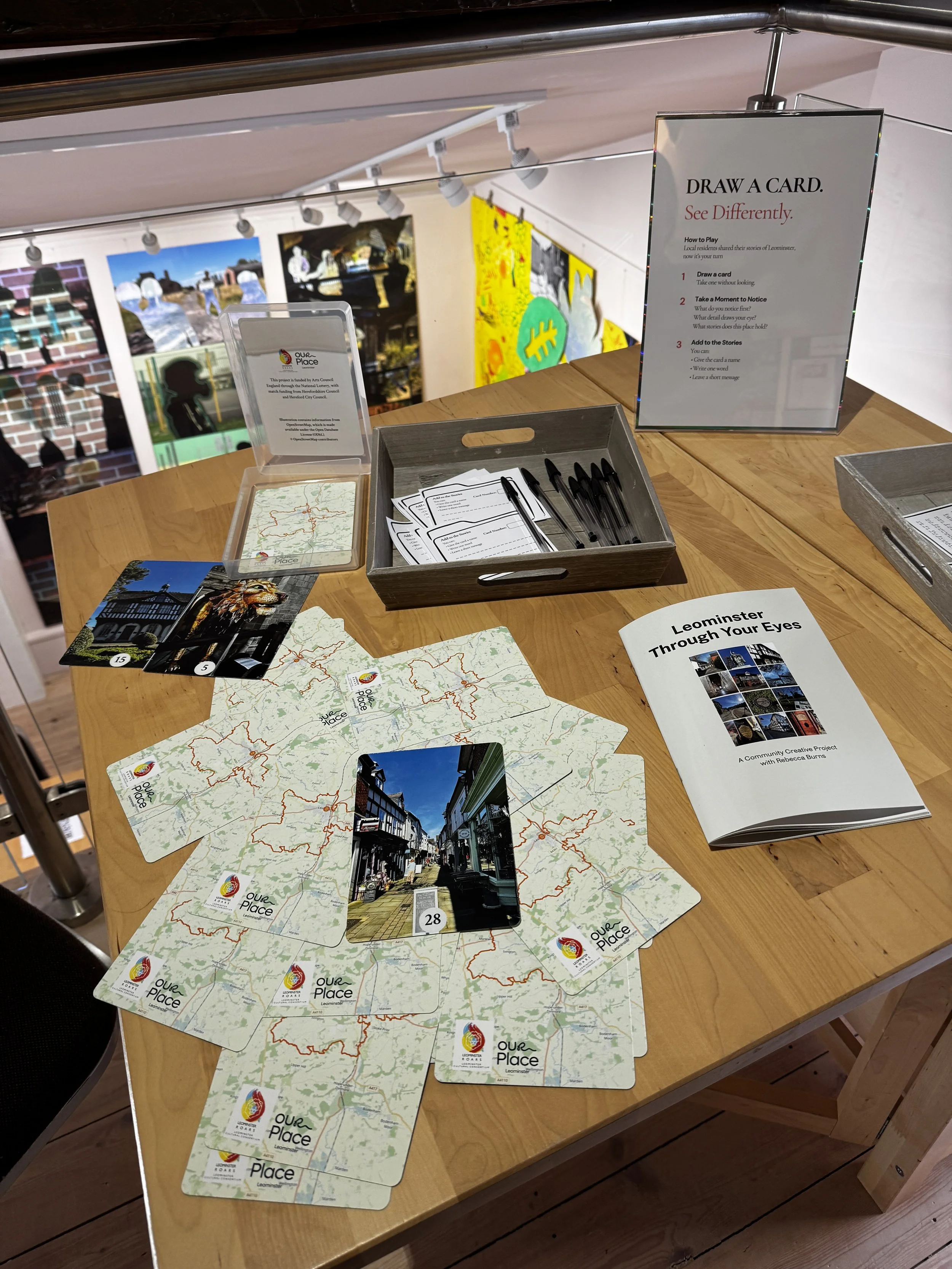
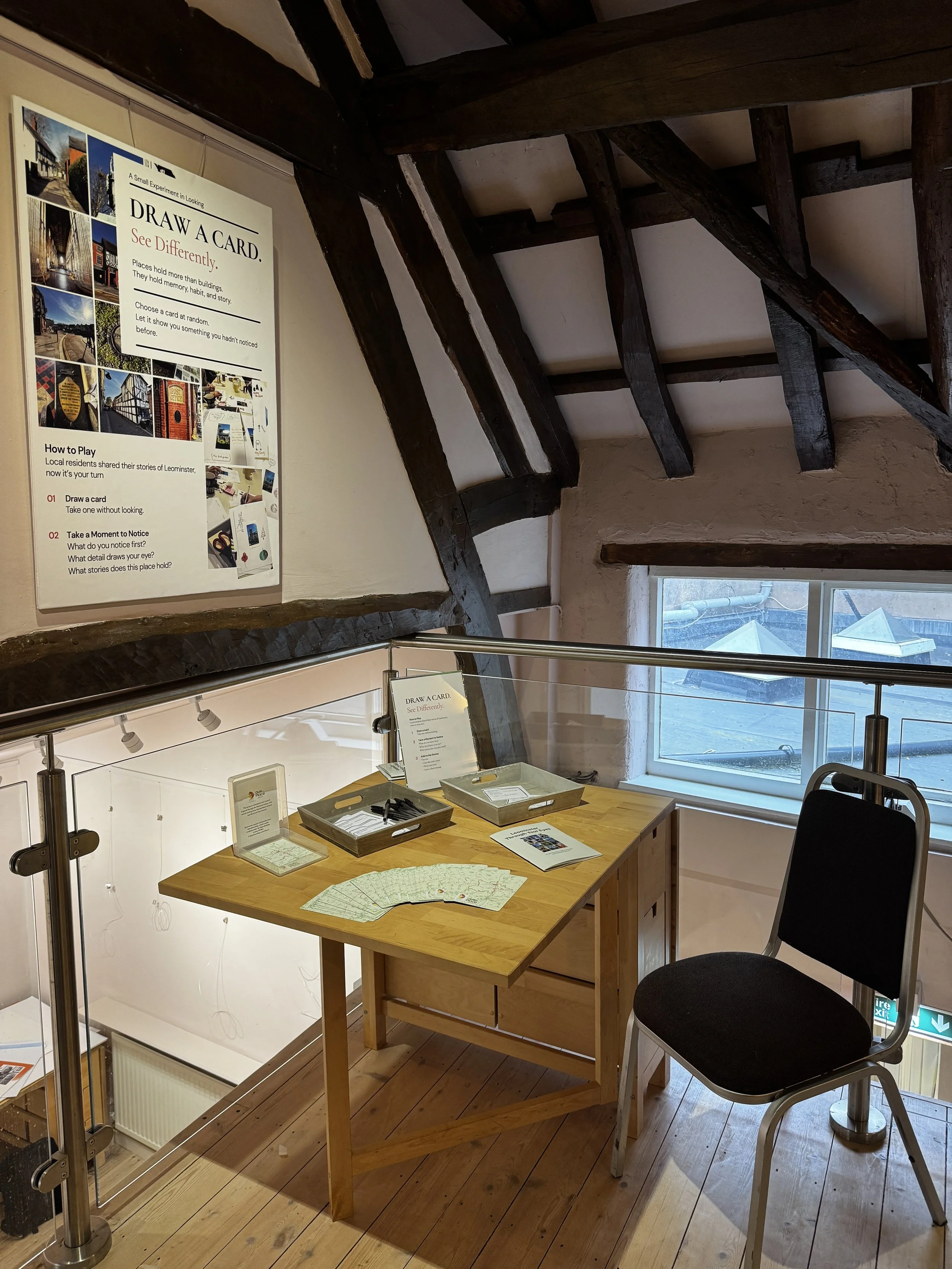
A series of small, facilitated sessions were held with local participants in community settings, culminating in an exhibition. Participants were invited to engage with a set of image-based Leominster cards showing local buildings, details, landmarks, and everyday places.
The sessions used:
open-ended prompts to guide attention
random card selection to interrupt habitual seeing
drawing, writing, conversation, and mapping as response methods
opportunities for participants to reflect on their own experiences of local places
The sessions were intentionally low-barrier and flexible, allowing people to respond in a way that felt most natural to them.
WHAT EMERGED
The pilot revealed that the cards acted as small prompts for attention, memory, and interpretation.
Participants did not respond to the images in one single way. Some used them as visual prompts, noticing architectural details, familiar buildings, routes, and landmarks. Others used them as invitations into conversation, linking places with personal memory, social history, humour, loss, work, routine, and belonging. In this sense, the cards became a way of moving between the visible features of place and the less visible meanings people attach to them.
Several key observations emerged:
The card format lowered the threshold for participation
People did not need prior historical knowledge, artistic confidence, or formal language about place. The image gave them something immediate to respond to.Random selection changed the encounter
Drawing a card introduced a small element of chance. This interrupted habitual ways of seeing and invited participants to meet familiar places from a new angle.Place-meaning was multiple and situated
The same card could generate different associations for different people, suggesting that local meaning is not fixed in the image itself but emerges through interpretation, memory, and conversation.Participation was shaped by setting
The room layout, group atmosphere, confidence levels, and facilitation style affected how people chose to respond. Some drew, while others preferred sharing through conversation.The cards worked as mediating objects
They gave participants a shared focus without demanding direct self-disclosure. This made it easier for personal stories and reflections to surface indirectly through place.
WHAT IT SHOWS
The Leominster micro-project suggests that connection to place can be invited, reawakened, and made more visible through small creative structures.
The project showed that place-based cards can function as participatory tools that:
invite people to notice overlooked details
open conversation around local memory and everyday experience
hold multiple meanings without requiring a single correct interpretation
create a bridge between personal story and shared place
support engagement across different levels of confidence, knowledge, and ability
The pilot also showed the importance of designing for flexibility. Drawing, writing, naming, talking, mapping, and simply noticing are not secondary activities. They are different routes into place-relationship. For some participants, the value was in making a visual response. For others, it was in the conversation that the card made possible.
This has become an important insight for the wider research: the power of the deck is not only in the images chosen, but in the practices the deck enables.
CONNECTION TO WIDER WORK
This micro-project helps inform the development of Oracle of Place, Rebecca Burns’ practice-based PhD research exploring how place-based oracle cards can mediate connection, memory, and community knowledge.
The Leominster pilot helped clarify several questions that now sit at the heart of the research:
How do image-based cards shape what people notice?
What happens when familiar places are encountered through chance, invitation, and interpretation?
How can a card deck hold local knowledge without fixing it into one official story?
How do material, portable objects help stories and meanings circulate beyond a single workshop or exhibition?
What forms of participation are opened by cards, and what forms are limited by them?
Rather than treating the deck as a finished output, the pilot reframed it as a research method: a way of exploring how people enter into relationship with place through images, prompts, conversation, memory, and repeated use.
The current PhD builds on these early experiments by asking not only whether creative place-based activity supports connection, but how the specific format of the oracle-style deck shapes that connection.
The Leominster pilot showed that ordinary places are more than backdrops to everyday life; they are threaded with memory, routine, story, care, and belonging. The cards offered a simple way to bring some of those meanings into view.
What began as a small local project has created the foundations for a wider body of research into how creative, place-based tools can help community knowledge remain visible, shareable, and alive.